There's a moment in most yoga classes when the teacher says "grab a block" and half the room hesitates. Reaching for a prop can feel like admitting defeat, as though a pose only counts if you manage it without help. The opposite is true. Props are tools for alignment, and alignment is what makes a shape useful rather than merely difficult. Used well, a block, a strap or a bolster lets you stay in a pose long enough to breathe, to feel where the stretch actually is, and to build the strength that makes the unassisted version possible later. Here's what each one does, when to reach for it, and how to choose your first set.
What Props Actually Do
Mostly three jobs. They bring the floor closer, they add length, and they take weight away. Almost every prop question comes down to which of those three you need in the moment.
Props also let you work at the edge of your range rather than past it. A tight hamstring in a seated forward fold is far better served by a strap around the feet and a long spine than by straining towards your toes with a rounded back. The pose looks less impressive and does considerably more.
Blocks: Bringing the Ground Up to You
Blocks bring the floor within reach. In half moon, triangle, low lunge or a standing forward fold, a block under the bottom hand means you can keep the spine long instead of collapsing sideways to get your fingers down.
Height matters, and most blocks give you three options: flat (lowest), on its long edge (medium), and upright (highest). Start high and work down as your range improves. If you're unsure, take the taller setting; it's easy to lower it next week, and much harder to un-round your lower back mid-pose.
Two blocks are often more useful than one. In a seated forward fold, sit on the front edge of a block to lift your hips above your knees, then place a second block under each hand so your torso has somewhere to land. That single change turns a stiff, collapsing fold into something you can hold for ten steady breaths.
The common mistake is choosing a height based on pride rather than on what keeps your back from rounding. Check in a mirror, or ask a teacher to look at your lower back from behind. If you can't tell the difference between a stretch and a strain, you've probably gone too low.
Straps: Length Where You Don't Have It
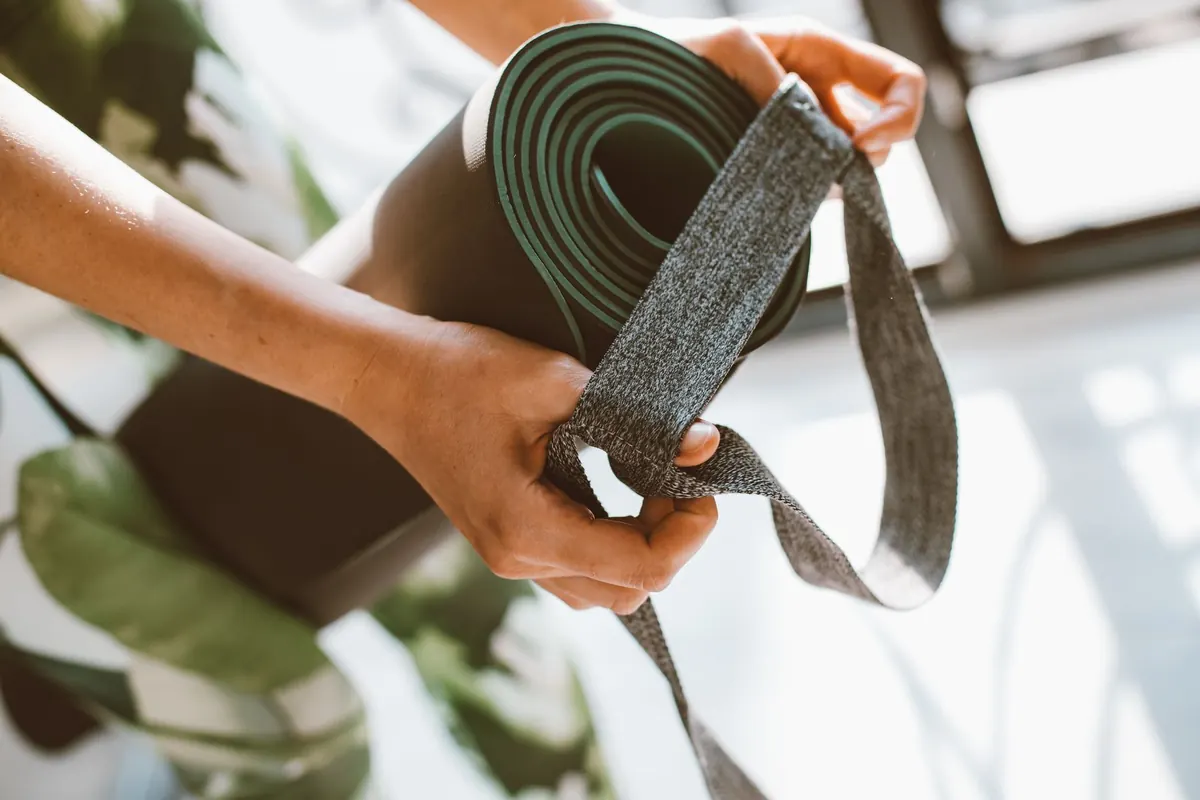
A strap creates a connection between hand and foot, or hand and hand, that your body can't quite make on its own. It doesn't stretch you; it lets you hold a shape long enough that the stretch happens by itself. A few places it earns its keep:
- Seated and supine forward folds. Loop the strap around the sole of the foot and hold one end in each hand, elbows soft.
- Reclining hand-to-big-toe. Strap around the foot, one leg up, the other long on the mat. The bottom leg stays heavy instead of lifting to compensate.
- Shoulder openers. In cow face arms, hold the strap between the hands and walk them a little closer every few weeks.
- Chest openers. A strap looped around the upper arms, hands behind the back, helps you broaden across the collarbones without jamming the shoulders.
Technique is simple: buckle the strap into a loop, hold it with arms slightly bent, and let it do the reaching. Never yank on it, and never force a joint towards a range it hasn't agreed to yet.
Bolsters: Support, Rest and Release
Bolsters take weight away. They hold a shape for you so your muscles can stop working, which is why restorative poses depend on them: supported bridge with a block or bolster under the sacrum, legs up the wall with support under the hips, savasana with a bolster under the knees or a rolled blanket beneath the neck.
Firmness matters more than shape. A bolster that squashes flat supports nothing, so if you're buying one, press it hard with both hands before deciding. At home, a rolled duvet or two firmly folded blankets will do the job.
A bolster under the knees during savasana is one of the simplest fixes there is for a lower back that aches when you lie flat. Try it before you decide you can't relax on your back.
Matching the Prop to the Problem
- Tight hamstrings or calves: strap in seated and supine folds.
- Tight shoulders or chest: strap for cow face arms and chest openers.
- Wrists complaining in downward dog: blocks under both hands, or come onto your forearms.
- Lower back ache in backbends or rest: bolster under the knees.
- Hips sitting lower than the knees: block or folded blanket under the sitting bones.
- Wobbly balance in standing poses: block under the bottom hand until the wobble settles.
- Low-energy days: bolster for supported resting shapes rather than a strong flow.
If you're working with an injury, are pregnant, or have a health condition, get individual guidance from a qualified teacher or health professional before moving into new ranges.
Using What You Already Have
You don't need to buy anything to start. Work through this list:
- Thick books or a sturdy box instead of blocks. Choose something solid, not soft.
- A dressing-gown cord, a belt or a rolled towel instead of a strap. Check it won't slip through your grip.
- A rolled duvet, a firm sofa cushion or two folded blankets instead of a bolster.
- A clear wall for legs up the wall, and a dining chair for supported seated poses.
Whatever you substitute, it needs to be stable. Never balance on something that rocks, and don't use anything you'd mind falling off.
Buying Your First Props
Start with two blocks and one strap. Cork blocks are dense and stable; foam ones are lighter and cheaper if you're only testing the water. Look for a strap with a firm buckle and enough width to sit comfortably across your palm rather than cutting into it. Add a bolster later, once you know you enjoy restorative or yin-style practice.
The test of any prop is straightforward: does it let you breathe and stay longer? If yes, keep using it. As a pose opens up, lower the block a notch, shorten the strap loop, or move the bolster to one side. Props aren't a stage you graduate from; they're a dial you adjust.
Photo: ROMAN ODINTSOV / Pexels