Twenty minutes is enough. Not enough to make you flexible, not enough to undo a decade of desk sitting, but enough to move every major joint, wake up your breathing, and reach breakfast feeling like a person rather than a stack of unfinished tasks. This sequence is built for anyone who has never taken a yoga class, or who took one years ago and remembers mainly the bit at the end where you lie on the floor. Everything is slow, nothing demands flexibility, and you can wear whatever you slept in.
Practise on a mat, a rug or a carpeted floor. Bare feet help you feel the ground. That is the entire equipment list.
Before You Begin: Four Ground Rules
Two minutes of preparation makes the difference between a flow you enjoy and one you abandon on day three. Set yourself up like this:
- Start before you check your phone. The moment you read a message, your attention is gone for the day. Get up, use the bathroom, unroll the mat.
- Warm the room a little. Cold muscles feel stiff and uncooperative. A jumper you can peel off halfway through works well.
- Put a glass of water nearby. You lose fluid overnight, so sip as you go.
- Fix the time. Twenty minutes, timer set, no negotiating. If you only have ten, do the first half and stop there.
If you are pregnant, recovering from an injury or managing a health condition, speak to your doctor or a qualified teacher before starting something new. A physiotherapist can also tell you which of these shapes to leave out.
The Sequence, Minute by Minute
Set a timer for twenty minutes so you are not glancing at a clock. Move between shapes on the breath — one movement per inhale or exhale. Slow is the instruction, not a suggestion.
Minutes 1–3: Sit and Breathe
Sit cross-legged, or on a cushion if your hips feel tight, hands resting on your knees. Close your eyes. Breathe in through the nose for a count of four, out for six. Keep the shoulders soft; the exhale should feel like a long sigh rather than a push. If sitting cross-legged is uncomfortable, sit on a chair with your feet flat on the floor — it counts. This is not the dull bit before the real thing. It is what makes the rest of the sequence feel calm rather than rushed.
Minutes 3–8: Wake the Spine
Come onto hands and knees, wrists under shoulders, knees under hips. Move slowly between two shapes:
- Cat: exhale, round the spine, tuck the chin, push the floor away.
- Cow: inhale, drop the belly, lift the chest and tailbone.
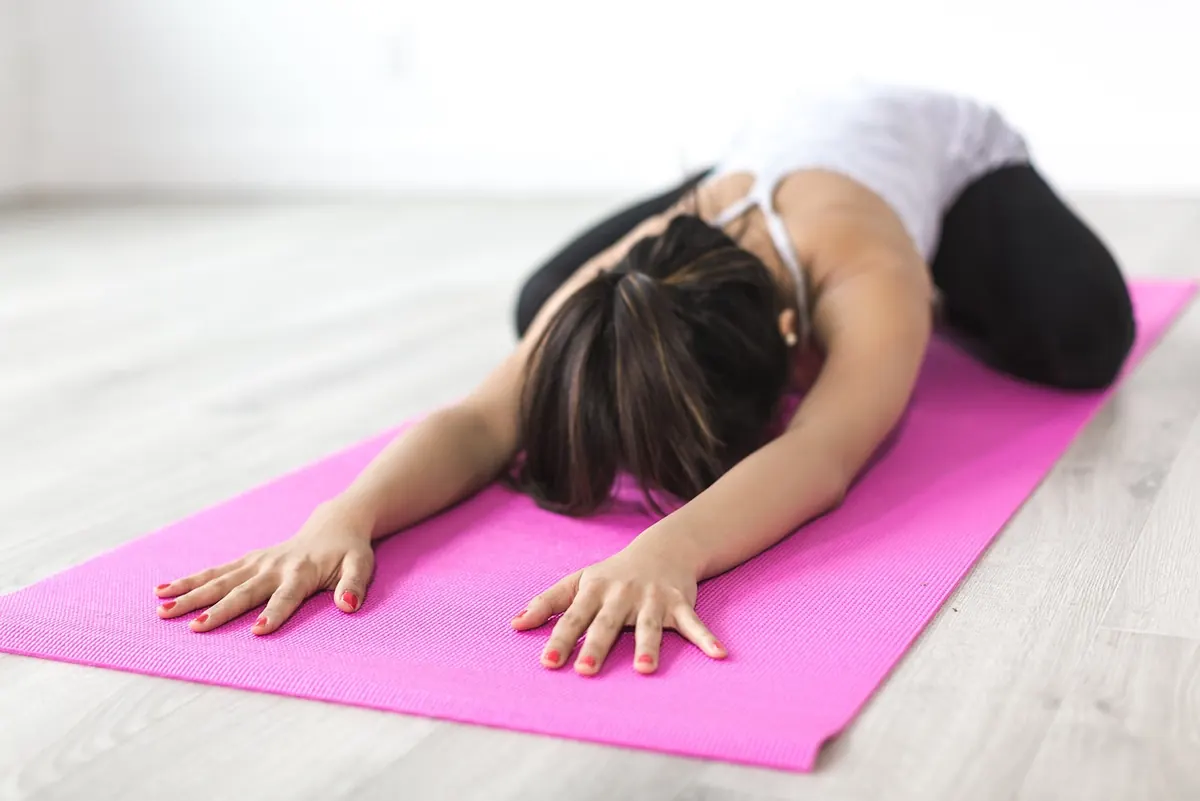
Repeat for ten to twelve rounds, letting the breath lead. Then push back into child's pose: knees wide, hips towards the heels, arms stretched forward, forehead down. Stay for five slow breaths. If your knees complain, fold a towel behind them or sit back on a cushion.
Minutes 8–14: Stand and Move
Walk your hands back up and stand with your feet hip-width apart, arms by your sides. This is mountain pose, and it is a pose, not a waiting room. Feel both feet pressed evenly into the floor.
- Inhale, sweep the arms overhead.
- Exhale, fold forward with the knees generously bent, hands to the floor or resting on your shins.
- Inhale, half lift: lengthen the spine, fingertips forward, gaze down.
- Exhale, fold again.
- Inhale, roll up slowly, one vertebra at a time.
Repeat that four or five times. Then step the left foot back into a low lunge, right knee over the ankle, hands on the front thigh. Hold for three breaths and swap sides. If the back knee is sore, fold a blanket underneath it. On each exhale, let the hips sink a centimetre; that is all the stretch you need.
Minutes 14–18: Twist and Open
From standing, take the feet wide. Turn the right toes out, keep the left foot pointing forward, and bend the right knee into a gentle warrior two, arms reaching in opposite directions. Three to five breaths, then switch sides.
Finish this block seated: cross-legged, right hand on the left knee, left hand behind you, twisting gently to the left on an exhale. Hold for three breaths, unwind, repeat on the other side. A twist should feel like wringing out a cloth, never like forcing a joint.
Minutes 18–20: Lie Down and Stop
Lie on your back, arms slightly away from the body, palms up, legs long. This is savasana. Let everything be heavy. If lying flat strains your lower back, bend the knees and let them rest together, or slide a cushion under them. Two minutes feels short, and that is the point: it tells your body the sequence is finished. When the timer goes, roll onto one side, pause, then press up.
Adapting It to Your Body
Nothing here is compulsory. Change whatever needs changing:
- Sore wrists in cat-cow? Make loose fists, or rest your forearms on a cushion.
- Tight hamstrings in the forward fold? Bend the knees more than feels necessary.
- Light-headed on standing? Keep your eyes open, move slower, pause in mountain pose.
- Short on time? Do minutes 1–3 and 18–20 and skip the middle. Twenty minutes is a target, not a rule.
Making It a Habit That Lasts
Most morning routines fail because they are too ambitious. This one is deliberately small. Unroll the mat the night before and leave it where you will step on it. Same time, same spot, so the decision is already made. Keep a paper calendar and put a cross in the box each time you finish; a visible row of crosses is quietly persuasive. Missing one day is fine. Missing two in a row is where habits slip, so if that happens, do five minutes rather than nothing. And resist adding more poses for the first fortnight.
Your First Week, Practically
For the first three mornings, do only the seated breathing and the cat-cow rounds — eight minutes at most. You are learning the shape of the routine, not the full sequence. From day four, add the standing block. By the end of the week you will be moving through all twenty minutes without checking the timer, which is when it starts to feel less like an exercise plan and more like the first good decision of the day.
If a pose hurts, stop. Discomfort from a stretch is one thing; sharp pain, numbness or tingling is your cue to come out and, if it persists, to ask a health professional about it.
Photo: StockSnap / Pixabay